
Fraction mistakes often look careless when they are actually logical misunderstandings. A child may add the top and bottom numbers because that works with whole numbers, divide by the numerator first because it appears first, or compare denominators without considering the size of each part.
The most useful question is not simply “What is the correct answer?” It is “What rule did you think you were using?” Once the reason is visible, the correction becomes much easier to remember.
Use the fraction error check
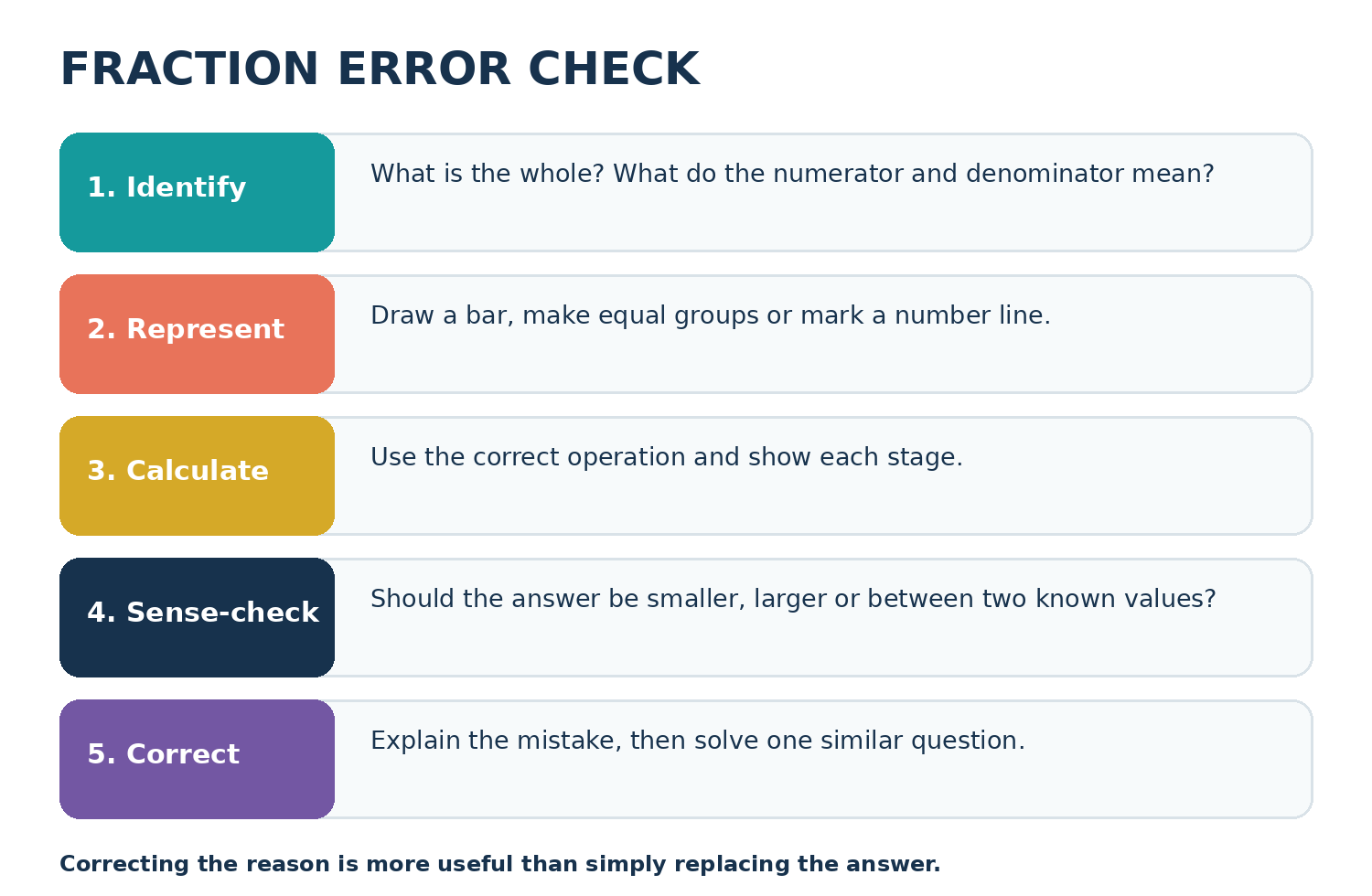
Mistake 1: Treating unequal parts as fractions
If a shape is split into four pieces of different sizes, each piece is not automatically one quarter. Fractions describe equal parts of a whole.
Example. A rectangle is divided into four equal strips and three are shaded. The shaded fraction is 3/4. If the strips are unequal, the picture does not show quarters.
“Are all the parts the same size? How could you prove it?”
Mistake 2: Thinking a larger denominator means a larger fraction
For unit fractions, more equal divisions make each part smaller. Therefore 1/8 is smaller than 1/6 when the wholes are equal.
Worked correction. Compare both with a familiar benchmark. 5/8 is greater than 1/2 because 4/8 equals 1/2. Meanwhile 3/7 is less than 1/2 because half of 7 is 3.5. Therefore 5/8 > 3/7.
Mistake 3: Adding denominators
Incorrect: 2/7 + 3/7 = 5/14. The denominator names the size of the parts. Because both fractions are sevenths, the part size does not change: 2/7 + 3/7 = 5/7.
When denominators differ, make equivalent fractions first. For example, 1/3 + 1/6 = 2/6 + 1/6 = 3/6 = 1/2.
Adding two positive fractions must give an answer larger than either starting fraction. 5/14 is smaller than 3/7, so it cannot be correct.
Practise the misconception, not only the question
PrepPath gives your child structured SEAG-style practice, clear explanations and progress tracking — all managed through your parent account.
Mistake 4: Dividing by the wrong number in a fraction of an amount
To find 3/5 of 40, divide by the denominator to find one fifth, then multiply by the numerator: 40 ÷ 5 = 8; 8 × 3 = 24.
Common wrong route: 40 ÷ 3 × 5. The denominator tells us how many equal groups make the whole, so it controls the first division.
“If 40 is the whole, what is one fifth? Now how many fifths do we need?”
Mistake 5: Cancelling numbers that are not factors
Fractions simplify by dividing the numerator and denominator by the same factor. Crossing out digits because they look alike is unreliable.
Correct: (18 ÷ 6)/(24 ÷ 6) = 3/4. Both 18 and 24 are divisible by 6. A child should be able to name the shared factor used.
Mistake 6: Mixing up improper fractions and mixed numbers
To convert 11/4, ask how many complete groups of four fit into eleven. Two groups use eight quarters, with three quarters remaining. Therefore 11/4 = 2 3/4.
Reverse check: 2 3/4 = (2 × 4 + 3)/4 = 11/4. A frequent error is adding 2 + 4 + 3 or forgetting that each whole contains four quarters.
Mistake 7: Using the wrong whole
Question. Twelve of 30 pupils bring lunch. What fraction bring lunch? The numerator is the selected group, 12. The denominator is the whole group, 30. So 12/30 simplifies to 2/5.
If the question asks what fraction do not bring lunch, first find 30 − 12 = 18. The answer is 18/30 = 3/5. The denominator remains 30 because the whole class has not changed.
Mistake 8: Confusing a fraction of the remainder with the original amount
Question. A box contains 60 counters. One third are red. Then one quarter of the remaining counters are blue. How many are blue?
- Red counters: 1/3 of 60 = 20.
- Remaining counters: 60 − 20 = 40.
- Blue counters: 1/4 of 40 = 10.
The quarter applies to the remaining 40, not the original 60. Circle phrases such as “of the remainder” before calculating.
Mistake 9: Matching fractions, decimals and percentages incorrectly
| Fraction | Decimal | Percentage |
|---|---|---|
| 1/2 | 0.5 | 50% |
| 1/4 | 0.25 | 25% |
| 3/4 | 0.75 | 75% |
| 1/5 | 0.2 | 20% |
| 1/10 | 0.1 | 10% |
A common place-value error is writing 1/4 as 0.4. But 0.4 means four tenths, which equals 2/5. Encourage children to learn benchmark equivalents and check whether the size feels sensible.
Mistake 10: Ignoring the final instruction
A child may correctly find 12/30 but lose the mark when the instruction asks for the answer in its simplest form. Finish by rereading the final phrase: simplest form, mixed number, decimal, percentage or particular unit.
How to review a wrong fraction answer
| Ask | Why it helps |
|---|---|
| What did you think the numerator represented? | Checks the selected parts. |
| What did you think the denominator represented? | Checks the whole and part size. |
| Can you draw or group it? | Makes the relationship visible. |
| Should the answer be bigger or smaller? | Builds estimation and sense-checking. |
| Can you solve one similar example alone? | Tests whether the correction transferred. |
Try these quick checks
- Which is greater: 3/5 or 3/8? Answer: 3/5, because fifths are larger than eighths when the numerator is the same.
- Calculate 2/9 + 4/9. Answer: 6/9 = 2/3.
- Find 3/8 of 56. Answer: 56 ÷ 8 × 3 = 21.
- Convert 13/5 to a mixed number. Answer: 2 3/5.
- A class has 32 pupils and 24 are present. What fraction are present in simplest form? Answer: 24/32 = 3/4.
Do not stop when your child can follow the correction. Change the numbers and ask them to complete one similar example independently. That is the best quick test of whether the misunderstanding has been replaced.
This guide is the diagnostic companion to Fractions Made Easier for SEAG. For the related skill, see Ratios and Proportion: A Parent-Friendly Guide, and for where fractions sit within the wider specification, see Common SEAG Maths Topics.
Turn helpful advice into confident practice
PrepPath gives your child structured SEAG-style practice, clear explanations and progress tracking — all managed through your parent account.
PrepPath is an independent preparation resource and is not affiliated with or endorsed by the Schools’ Entrance Assessment Group.