
Fractions become much easier when a child can see what the numbers mean. The goal is not to race through a list of rules. It is to connect the picture, the calculation and the words in the question.
SEAG states that its Mathematics content is based on the statutory Northern Ireland Key Stage 2 curriculum and includes Numbers. Fractions sit within that wider number knowledge and may also appear through money, measures or problem-solving contexts. This guide teaches the underlying skills; it does not predict a particular assessment question.
What a fraction actually means
A fraction describes equal parts of one whole or equal parts of a quantity. In 3/5, the denominator 5 tells us the whole has been divided into five equal parts. The numerator 3 tells us that three of those parts are being considered.
Ask, “What is the whole, how many equal parts does it have, and how many parts are we using?”
Equivalent fractions
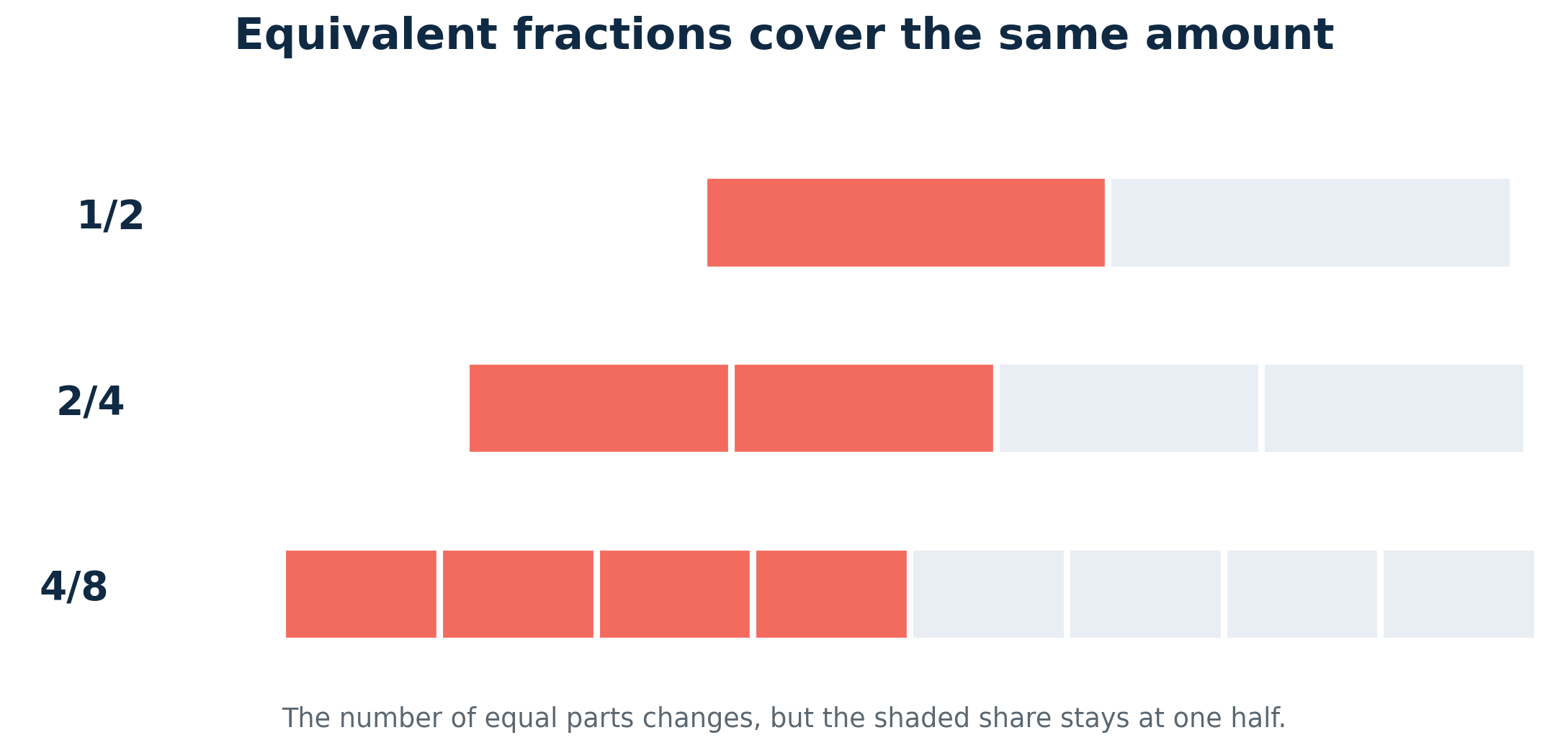
Equivalent fractions look different but represent the same amount. If every part is split into two smaller equal parts, both the numerator and denominator double. The value has not changed.
Worked example 1
Complete the statement: 3/4 = ?/12.
- The denominator changes from 4 to 12, so it has been multiplied by 3.
- Multiply the numerator by the same number: 3 × 3 = 9.
- Therefore, 3/4 = 9/12.
Changing only the denominator changes the value of the fraction. Whatever multiplication or division is applied to the denominator must also be applied to the numerator.
Simplifying fractions
Simplifying means writing the same value using smaller numbers. Divide the numerator and denominator by a common factor.
Worked example 2
Simplify 18/24.
- Both numbers are divisible by 6.
- 18 ÷ 6 = 3 and 24 ÷ 6 = 4.
- So 18/24 = 3/4. The fraction cannot be simplified further because 3 and 4 share no factor greater than 1.
Build understanding with regular practice
PrepPath can give your child structured SEAG-style maths practice and explanations while you follow progress through the parent account.
Comparing fractions
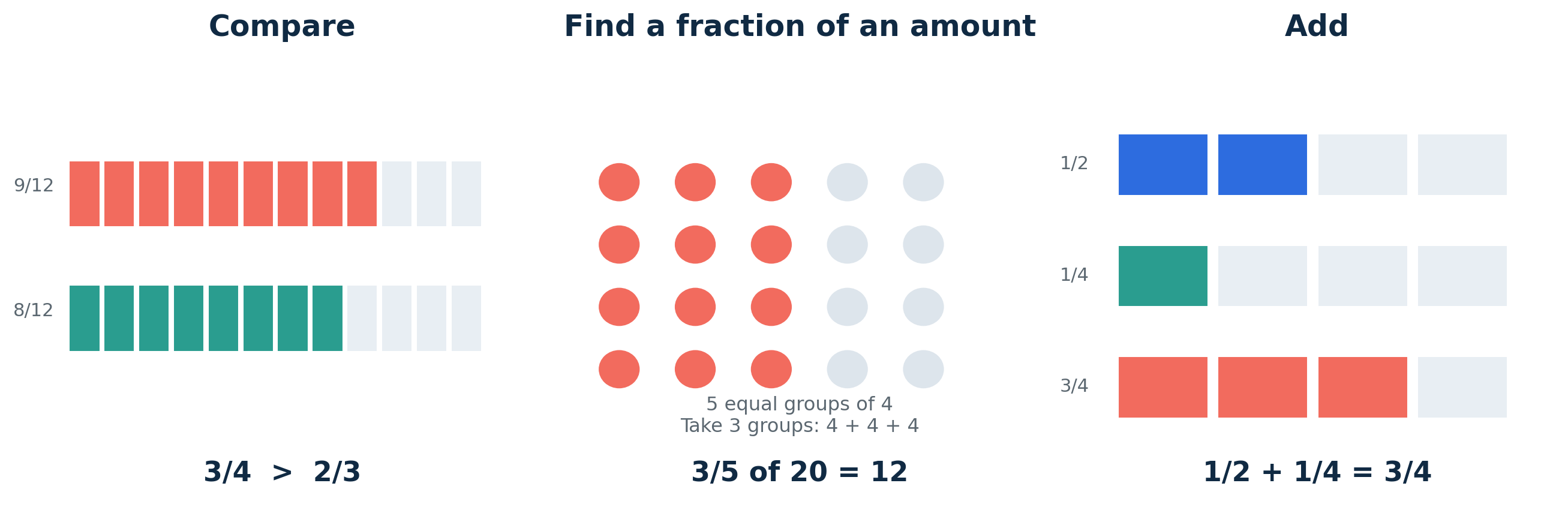
When denominators match, the fraction with the larger numerator is larger. When denominators differ, convert both fractions to a common denominator or use a reliable visual model.
Worked example 3
Which is greater: 3/4 or 2/3?
- The lowest common multiple of 4 and 3 is 12.
- 3/4 = 9/12.
- 2/3 = 8/12.
- Since 9/12 is greater than 8/12, 3/4 is greater than 2/3.
Finding a fraction of an amount
For 3/5 of 20, divide by the denominator first and multiply by the numerator: 20 ÷ 5 = 4, then 4 × 3 = 12. The answer is 12.
A child who understands the model can also see five equal groups of four and select three groups. This reduces the chance of multiplying and dividing in the wrong order.
Adding and subtracting fractions
Fractions can be added or subtracted when their parts are the same size. Keep a shared denominator and work with the numerators. If the denominators differ, make equivalent fractions first.
Worked example 4
Calculate 1/2 + 1/4.
- Convert one half into quarters: 1/2 = 2/4.
- Add the numerators: 2/4 + 1/4 = 3/4.
- Keep the denominator 4 because the answer is still counting quarter-sized parts.
Improper fractions and mixed numbers
An improper fraction has a numerator at least as large as its denominator. A mixed number combines a whole number and a fraction.
Worked example 5
Convert 11/4 into a mixed number.
- Four quarters make one whole.
- 11 ÷ 4 = 2 remainder 3.
- Therefore, 11/4 = 2 3/4.
Fractions, decimals and percentages
Children should recognise useful connections between common forms. Understanding these benchmarks helps with estimation and comparison.
| Fraction | Decimal | Percentage |
|---|---|---|
| 1/2 | 0.5 | 50% |
| 1/4 | 0.25 | 25% |
| 3/4 | 0.75 | 75% |
| 1/5 | 0.2 | 20% |
| 1/10 | 0.1 | 10% |
Worked example. A class has completed 3/5 of a project. Because 1/5 is 20%, three fifths is 60%. As a decimal, it is 0.6.
A multi-step word problem
Maya has 36 stickers. She gives 1/3 of them to Ben, then gives 1/4 of the original 36 to Aisha. How many stickers does Maya have left?
- Ben receives 36 ÷ 3 = 12 stickers.
- Aisha receives 36 ÷ 4 = 9 stickers. The wording says one quarter of the original amount.
- Maya gives away 12 + 9 = 21 stickers.
- She has 36 − 21 = 15 stickers left.
If the question had said one quarter of the remaining stickers, the second calculation would be different. Encourage your child to underline what each fraction refers to.
Common fraction mistakes
| Mistake | Better habit |
|---|---|
| Adding denominators as well as numerators | Ask whether the parts are already the same size. |
| Multiplying only one part of an equivalent fraction | Apply the same operation to numerator and denominator. |
| Finding 3/5 by dividing by 3 | Divide by the denominator 5, then multiply by the numerator 3. |
| Comparing only the numerators | Use a common denominator or visual model. |
| Ignoring the whole in a word problem | State what one whole represents before calculating. |
Try these with your child
| Question | Answer |
|---|---|
| 1. Complete: 2/3 = ?/12 | 8/12 |
| 2. Simplify 15/25 | 3/5 |
| 3. Which is larger: 5/8 or 2/3? | 2/3 because 5/8 = 15/24 and 2/3 = 16/24 |
| 4. Find 3/7 of 42 | 18 |
| 5. Calculate 3/10 + 2/5 | 7/10 |
| 6. Calculate 5/6 − 1/3 | 1/2 |
| 7. Convert 9/4 to a mixed number | 2 1/4 |
| 8. Write 3/4 as a decimal and percentage | 0.75 and 75% |
A useful ten minute practice routine
- Two minutes: represent one fraction with a quick sketch or household objects.
- Three minutes: complete one calculation and explain every step aloud.
- Three minutes: solve one short word problem.
- Two minutes: correct one mistake and name what caused it.
Stop while the explanation is still clear. A short session that fixes one misunderstanding is more valuable than a long page completed by guessing.
Ratios and fractions share the same underlying logic of equal parts — our Ratios and Proportion: A Parent-Friendly Guide covers that connection directly. For where fractions sit within the wider maths specification, see Common SEAG Maths Topics, and for a week-by-week structure to fit practice around, see our 8-week SEAG revision plan.
Turn the next weak area into a clear practice goal
Create a PrepPath account for structured questions, explanations and parent-friendly progress tracking.
PrepPath is an independent preparation resource and is not affiliated with or endorsed by the Schools’ Entrance Assessment Group.