
Ratio and proportion questions become easier when a child stops treating the colon as a mysterious symbol. A ratio compares quantities. Proportion describes how those quantities stay connected when a situation is scaled up or down.
SEAG bases its Mathematics content on the statutory Northern Ireland Key Stage 2 curriculum. Ratio and proportion draw on number knowledge and can appear in contexts involving money, measures and problem solving. These examples teach the skill rather than predict an individual assessment question.
What does a ratio mean
The ratio 2:3 can mean that for every two blue counters there are three coral counters. The order matters: blue to coral is 2:3, while coral to blue is 3:2.
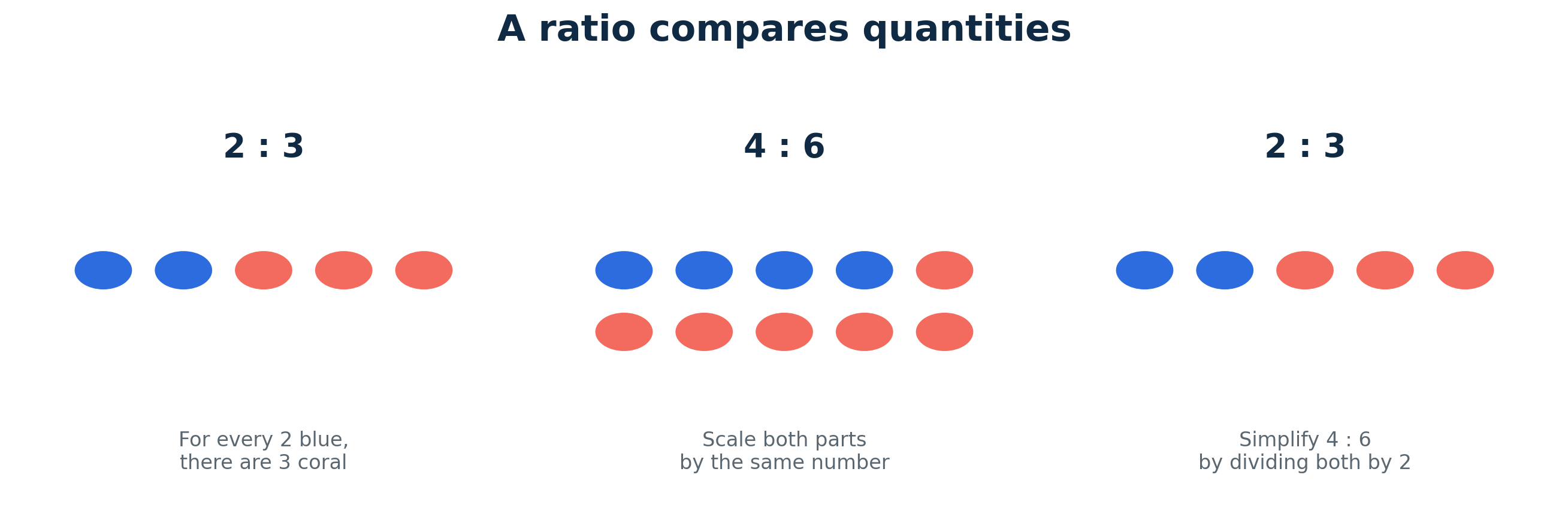
Ask your child to say the comparison aloud before writing it: “blue to coral”. This helps prevent reversing the ratio.
Part to part and part to whole
If a group contains 2 blue counters and 3 coral counters, blue to coral is 2:3. There are 5 counters altogether, so blue to total is 2:5. This distinction connects ratio to fractions: 2/5 of the counters are blue and 3/5 are coral.
Worked example 1
A bag contains 6 red beads and 9 green beads. Write the ratio of red to green in its simplest form, then write the fraction that are red.
- Red to green is 6:9.
- Divide both parts by their highest common factor, 3: 6:9 = 2:3.
- There are 6 + 9 = 15 beads altogether.
- The fraction that are red is 6/15 = 2/5.
Simplifying a ratio
Simplify a ratio by dividing every part by the same common factor. A ratio with three parts follows the same rule: 12:18:24 simplifies to 2:3:4 because every part is divided by 6.
Do not subtract the same number from both parts. Equivalent ratios are created by multiplying or dividing every part by the same factor.
Move from explanation to guided practice
PrepPath can provide structured SEAG-style maths practice and clear explanations while you follow progress through the parent account.
Scaling a ratio up or down
Worked example 2
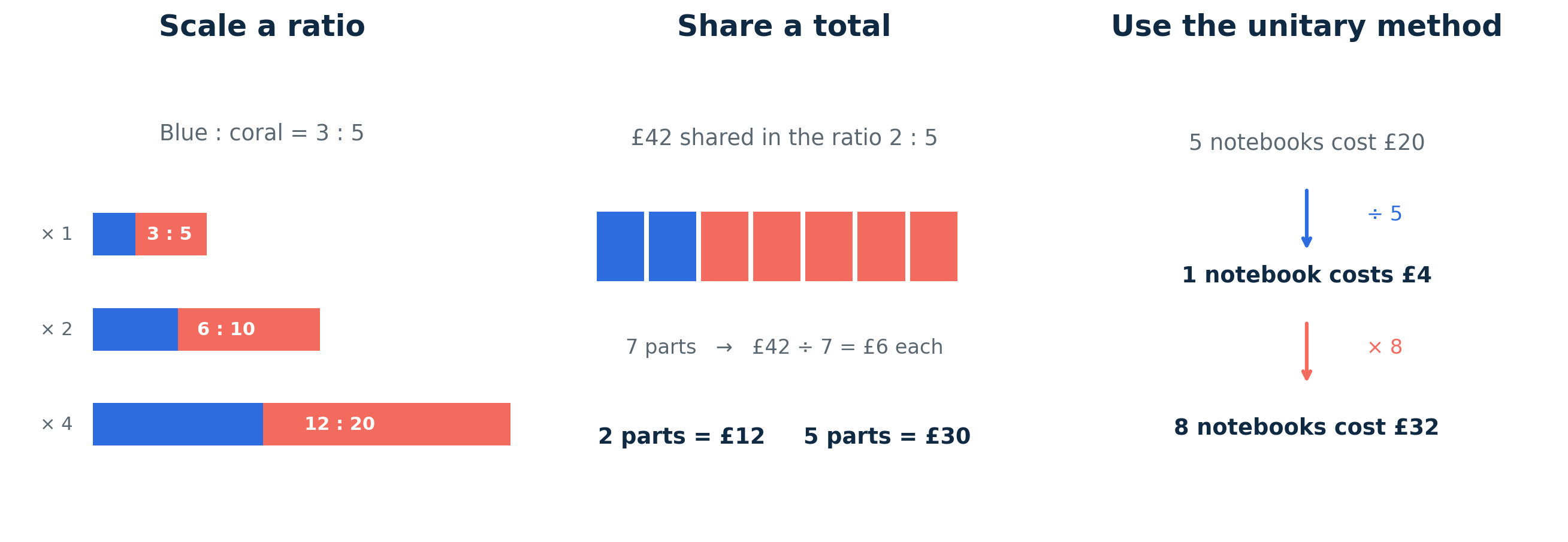
Blue and coral paint are mixed in the ratio 3:5. If 12 cups of blue paint are used, how many cups of coral paint are needed?
- The blue amount changed from 3 to 12. That is ×4.
- Apply the same scale factor to the coral amount: 5 × 4 = 20.
- The mixture needs 20 cups of coral paint.
The original ratio has more coral than blue, so an answer smaller than 12 would not make sense.
Sharing a total in a ratio
Worked example 3
Share £42 between Ava and Noah in the ratio 2:5.
- Count the total number of parts: 2 + 5 = 7.
- Find one part: £42 ÷ 7 = £6.
- Ava receives 2 × £6 = £12.
- Noah receives 5 × £6 = £30.
- Check: £12 + £30 = £42.
Dividing £42 by 2 and then by 5 does not create two shares of the same total. Find the value of one of the seven equal parts first.
Using the unitary method for proportion
The unitary method means finding the value for one unit before scaling to the required number. It is reliable because each stage has a clear meaning.
Worked example 4
Five notebooks cost £20. How much do eight notebooks cost at the same price?
- Find the cost of one notebook: £20 ÷ 5 = £4.
- Scale to eight notebooks: £4 × 8 = £32.
- Therefore, eight notebooks cost £32.
Recipes and measures
Worked example 5
A drink uses orange and water in the ratio 1:4. How much water is needed with 350 ml of orange?
- Orange represents one part, so one part is 350 ml.
- Water represents four parts: 4 × 350 ml = 1,400 ml.
- The amount of water needed is 1.4 litres.
Complete the ratio calculation before converting units. Remember that 1,000 ml = 1 litre.
Finding a missing value
Worked example 6
Four cinema tickets cost £30. What would ten tickets cost at the same rate?
- One ticket costs £30 ÷ 4 = £7.50.
- Ten tickets cost £7.50 × 10 = £75.
- The answer assumes every ticket has the same price.
When direct proportion applies
Direct proportion applies when both quantities change by the same scale factor. If the number of identical items doubles, the total cost doubles. But not every real situation is proportional: a taxi fare with a fixed starting charge or a “buy one, get one free” offer needs different reasoning.
Ask, “If one amount doubles, should the other definitely double here?” This helps your child decide whether proportional reasoning is appropriate.
Common ratio and proportion mistakes
| Mistake | Better habit |
|---|---|
| Reversing the order | Write the named comparison above the numbers. |
| Changing only one side of a ratio | Use the same multiplier or divisor for every part. |
| Confusing part-to-part with part-to-whole | Calculate the total before writing a fraction of the whole. |
| Sharing by dividing separately by each ratio number | Add the ratio parts, find one part, then multiply. |
| Assuming every situation is proportional | Check whether both quantities really change by the same factor. |
| Dropping or mixing units | Write the expected unit before calculating. |
Try these with your child
| Question | Answer |
|---|---|
| 1. Simplify 10:15 | 2:3 |
| 2. Simplify 18:24:30 | 3:4:5 |
| 3. Red to blue is 4:7. If there are 20 red, how many blue? | 35 |
| 4. Share £64 in the ratio 3:5 | £24 and £40 |
| 5. Flour to sugar is 5:2. If flour is 750 g, how much sugar? | 300 g |
| 6. Six pens cost £9. What do ten cost? | £15 |
| 7. Boys to girls is 3:5. What fraction of the group are boys? | 3/8 |
| 8. A map scale is 1 cm to 4 km. What does 7.5 cm represent? | 30 km |
A useful ten minute practice routine
- Two minutes: build or draw one ratio with two colours.
- Three minutes: simplify or scale two ratios and explain the shared factor.
- Three minutes: solve one sharing or unitary-method problem.
- Two minutes: check order, total and units, then correct one mistake.
Encourage your child to explain what one part represents. That sentence often reveals whether the numbers have meaning or the method is being copied mechanically.
Fractions and ratios share the same underlying logic of equal parts — our Fractions Made Easier for SEAG guide covers that connection directly. For where ratio and proportion sit within the wider maths specification, see Common SEAG Maths Topics, and for a week-by-week structure to fit practice around, see our 8-week SEAG revision plan.
Build confidence with the next ratio problem
Create a PrepPath account for structured questions, explanations and parent-friendly progress tracking.
PrepPath is an independent preparation resource and is not affiliated with or endorsed by the Schools’ Entrance Assessment Group.