Running out of time does not always mean a child works too slowly. Time can disappear when they reread a difficult question several times, pursue one method for too long, rush early and then correct avoidable mistakes, or lose track of unanswered questions.
Good time management is therefore not simply speed. It is knowing when to answer, when to pause, when to move on and how to return with a clear plan.
What good time management looks like
- Starting promptly without racing.
- Reading the exact instruction before calculating or choosing.
- Recognising when a question is taking too long.
- Making a deliberate mark or flag before moving on.
- Returning to unanswered questions systematically.
- Using spare time to check likely errors rather than staring at completed work.
Say, “Your job is not to be the fastest. Your job is to keep making sensible decisions.”
Teach a three-pass method
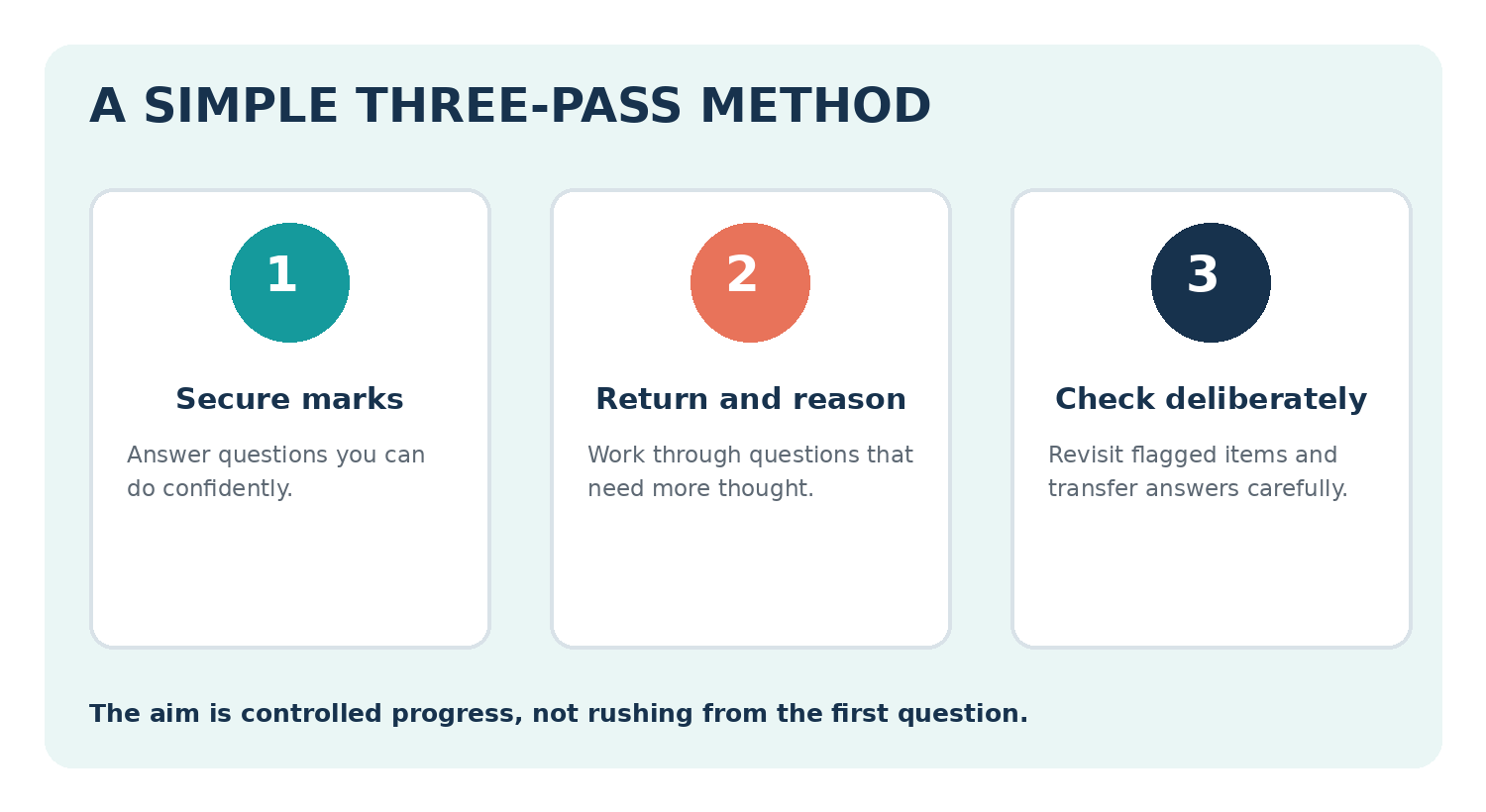
Pass 1: Secure the marks you can
Work through the paper in order and answer questions that feel manageable. If a child understands the task and is making progress, they should continue. If they are stuck with no useful next step, they should flag it and move on.
Pass 2: Return and reason
Return to flagged questions. Read the instruction again, identify the topic and try a fresh representation: underline key information, draw a bar model, estimate, eliminate options or locate evidence in the passage.
Pass 3: Check deliberately
Use remaining time for purposeful checks: unanswered items, answer transfers, units, operation signs, place value, question words such as not or closest, and whether an answer is reasonable.
Build calm timing habits through structured practice
PrepPath gives your child structured SEAG-style practice, clear explanations and progress tracking — all managed through your parent account.
The one-minute decision
Do not teach a universal one-minute limit. Instead, teach a decision point: after a reasonable attempt, can your child name a useful next step?
| If the child can say… | Decision |
|---|---|
| “I know the method; I need another calculation.” | Continue. |
| “I can eliminate two options and compare the others.” | Continue briefly. |
| “I have reread it but still do not know what it wants.” | Flag and move on. |
| “My working keeps returning to the same place.” | Flag and return with a different approach. |
Practise pacing without creating pressure
Begin with short, low-stakes activities. Timing should provide information, not punishment.
- Complete five familiar questions without a timer and note the natural time.
- Repeat with a visible timer, aiming for the same accuracy and a steady pace.
- Add one deliberately difficult question and practise choosing to flag it.
- Review where time was lost: reading, choosing a method, calculation, checking or answer transfer.
- Set one small goal for the next session, such as moving on sooner after becoming stuck.
Worked examples
A difficult question
Maya has spent a while on Question 14. She has read it three times, written no working and cannot say which topic it tests.
Unhelpful response: continue staring because leaving a question feels like giving up.
Better response: flag Question 14, move to Question 15 and return during Pass 2. Moving on protects time for questions she can answer and may reduce the mental block.
Checking with purpose
A child finishes a maths section and has several minutes left. Instead of recalculating everything, they check questions with common risk points: decimal place value, converted units, multi-step problems and any answer that looks unusually large or small.
A simple practice review
| Review question | What it reveals |
|---|---|
| Did you reach every question? | Overall pacing and moving-on decisions. |
| Which question used the most time? | A skill gap, overchecking or difficulty letting go. |
| Where did rushing cost a mark? | Reading, copying, units or arithmetic habits. |
| Did you return to every flag? | Whether the system is reliable. |
| What one change will you try next time? | A manageable next step. |
What parents should avoid
- Calling out the time repeatedly during ordinary learning.
- Comparing pace with another child.
- Treating every slow answer as a problem; careful reasoning can be valuable.
- Introducing full timed papers before methods are secure.
- Reviewing only whether the paper was finished and ignoring accuracy.
A balanced weekly approach
| Session | Main purpose |
|---|---|
| Untimed topic practice | Learn and explain the method. |
| Short timed set | Practise pace and moving on. |
| Mixed practice | Switch between topics and choose methods. |
| Occasional paper practice | Apply the full routine under realistic conditions. |
| Mistake review | Correct causes, not only answers. |
On assessment day
- Listen carefully to all instructions.
- Begin steadily; do not sprint through early questions.
- Use the practised flag-and-return routine.
- If attention slips, take one slow breath and restart with the next clear action.
- Check answer recording and any unanswered items if time remains.
For more on the final stretch before test day, see What to Do in the Last Week Before the Test, the 8-Week SEAG Revision Plan and our Test Day Checklist. If nerves are part of the challenge, see Helping an Anxious Child Prepare for SEAG.
Turn helpful advice into confident practice
PrepPath gives your child structured SEAG-style practice, clear explanations and progress tracking — all managed through your parent account.
PrepPath is an independent preparation resource and is not affiliated with or endorsed by the Schools’ Entrance Assessment Group.