
It is natural to step in when a child is stuck, especially when the method seems obvious. But explaining too much too soon can produce a completed page without producing independent understanding. Useful support makes the next step possible, then gives control back.
Use the smallest helpful prompt: the PrepPath parent support ladder
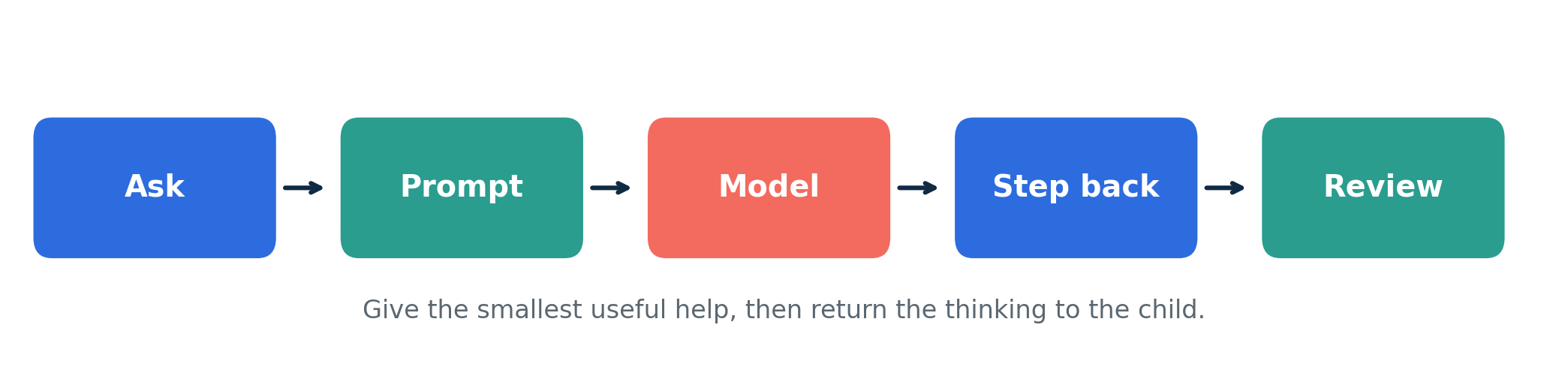
1. Ask what they understand
Begin with information, not correction: “What is the question asking?” “What do you already know?” “Which part feels confusing?” The answer tells you whether the difficulty is knowledge, wording, memory or confidence.
2. Give one prompt
Offer a clue that directs attention without revealing the method: “What unit should the answer use?” or “Where in the passage could you find evidence?” Wait long enough for the child to use it.
3. Model a similar example
If a prompt is not enough, demonstrate a different but closely related example. For 3/5 of 20, you might model 2/5 of 15, then return to the original question. Avoid changing only the numbers while completing the same answer for them.
4. Step back
Ask the child to attempt the original problem independently. Do not narrate every movement of the pencil or react to each choice. Productive struggle is part of learning when it remains manageable.
5. Review the reasoning
Whether the answer is right or wrong, ask for the method. A correct guess needs more attention than a wrong answer produced by a sensible method and one small error.
Support independent practice with useful explanations
PrepPath can provide structured questions and explanations while the child completes the thinking and parents follow progress.
What helpful support sounds like
| When the child says | Try saying |
|---|---|
| “I don’t understand any of it.” | “Tell me one thing the question gives you.” |
| “Just tell me what to do.” | “Which method does this look most like?” |
| “Is this right?” | “How could you check it without me?” |
| “I can’t find the answer.” | “Which paragraph or diagram is most likely to help?” |
| “I always get these wrong.” | “Let’s find the exact step where it changes.” |
| “Can you do the first one?” | “I’ll model a different example, then you try this one.” |
Worked examples
Maths
Question: A rectangle is 9 cm long and 4 cm wide. What is its area?
Taking over would be saying, “Multiply 9 by 4; the answer is 36 cm².” A better sequence is: “What does area measure?” then “Which two measurements matter?” If needed, model the area of a 5 cm by 3 cm rectangle. Then return to the original and ask the child to calculate and include the unit.
Comprehension
Question: How can you tell the character is disappointed?
Taking over would be pointing to the exact quotation. A better prompt is: “Which part shows what the character does or says after the result?” When the child locates a clue, ask: “What does that action suggest?” The child should connect the evidence to the feeling.
Know when to explain directly
Independent thinking does not mean leaving a child confused indefinitely. Direct teaching is appropriate when the underlying idea has never been learned, a misconception keeps repeating or frustration is rising. Explain one clear method, work through a similar example together, then ask the child to try a fresh question alone.
Praise the process you want repeated
- “You went back to the question and noticed the unit.”
- “You found evidence before choosing an answer.”
- “You checked the calculation in a different way.”
- “You stayed with the difficult step and changed your approach.”
- “You explained why the answer makes sense.”
Signs that help has become too much
| Sign | Adjustment |
|---|---|
| You are speaking more than the child | Ask one question and wait. |
| The child watches while you write | Put the pencil or keyboard back with the child. |
| Correct answers disappear when you leave | Return to a simpler example and check the underlying concept. |
| Every answer needs your approval | Build a self-check routine before the child asks. |
| Sessions repeatedly end in conflict | Shorten the session and separate teaching from testing. |
A simple rule for parent support
If your help changes the child’s thinking, it is teaching. If it replaces the child’s thinking, it is doing the task. Aim to leave your child able to explain the next step when you are no longer beside them.
For more on keeping preparation calm and supportive rather than pressured, see our guide on helping an anxious child prepare for SEAG, and for a week-by-week structure to fit this approach into, see our 8-week SEAG revision plan.
Let your child practise while you keep a clear overview
Create a PrepPath account for independent SEAG-style practice, useful explanations and parent-friendly progress tracking.
PrepPath is independent and is not affiliated with or endorsed by the Schools’ Entrance Assessment Group. This article provides general educational guidance for parents; it does not replace advice from a child’s teacher or support professional, particularly where a child has additional learning needs.