
Many comprehension mistakes are not caused by weak reading. A child may understand the passage but answer from memory, overlook a small word in the question or choose an option that sounds possible without being supported by the text.
A reliable strategy creates a pause between reading and answering. The child identifies what the question is asking, returns to the relevant part of the text and proves the answer before selecting it.
The five step answer route
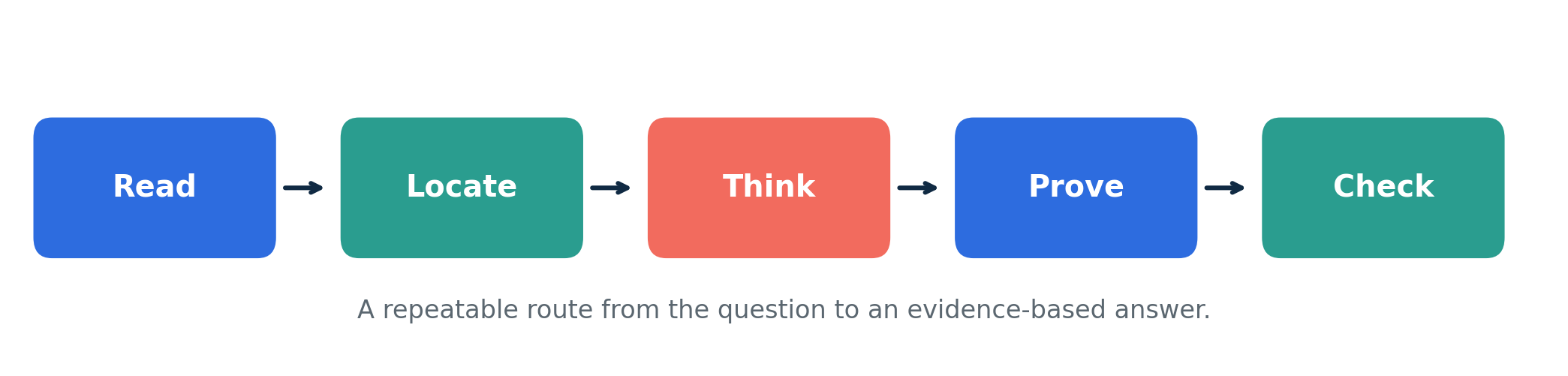
1. Read the question precisely
Notice command words and qualifiers such as mainly, most likely, according to the passage, first or best.
2. Locate the relevant section
Return to the sentence or paragraph that contains the clue. Do not rely only on a general memory of the passage.
3. Think about the meaning
Decide whether the question asks for a stated fact, an inference, vocabulary in context, sequence, purpose or language effect.
4. Prove the answer
Find a word, phrase or combination of clues that supports the choice. Eliminate answers that are merely possible.
5. Check the exact question
Make sure the chosen answer addresses every part of the wording and does not contradict another detail.
Practise proving answers with evidence
PrepPath gives children structured comprehension practice and explanations while parents can follow progress through their account.
Worked example: finding a stated fact
Passage: “Leah placed the seedlings on the kitchen windowsill because the frost had returned overnight. She planned to move them outside when the weather became warmer.”
Question: Why did Leah keep the seedlings indoors?
| Stage | Thinking |
|---|---|
| Locate | The first sentence explains the decision. |
| Evidence | “because the frost had returned overnight” |
| Answer | She kept them indoors to protect them from the frost or cold weather. |
| Trap to avoid | “Because she wanted them near the window” is possible, but it is not the stated reason. |
Worked example: making an inference
Passage: “Owen checked the clock again. The platform was almost empty, and the information screen still showed a delay. He pulled his coat tighter and sighed.”
Question: How is Owen most likely feeling?
A strong answer combines clues: checking the clock and sighing suggest impatience or frustration; the empty platform and delay explain why. “Cold” is also suggested, but the question asks about his feeling in the wider situation, so frustrated or fed up is better supported.
Question types and the clue to look for
| Question type | What to do |
|---|---|
| Literal retrieval | Find the detail stated directly and match the wording carefully. |
| Inference | Combine two or more clues; explain what they suggest. |
| Vocabulary in context | Replace the word with each option and check the meaning in that sentence. |
| Sequence | Track what happened before, during and after the event. |
| Main idea | Ask what most of the paragraph or passage is about, not one memorable detail. |
| Writer purpose | Consider whether the writer aims to explain, persuade, entertain, describe or instruct. |
| Language effect | Identify what the chosen word makes the reader picture, feel or understand. |
Worked example: vocabulary in context
Sentence: “The path narrowed abruptly, forcing the walkers into single file.”
If asked what abruptly means, test a replacement: suddenly fits both the meaning and the sentence. Quietly and eventually may sound plausible in another context, but they do not preserve the meaning here.
How to eliminate tempting answers
- Too broad: true generally, but not the answer to this question.
- Too narrow: repeats one detail while missing the main point.
- Half right: matches part of the question but fails another word such as mainly or first.
- Invented: could happen, but the passage gives no supporting clue.
- Opposite or distorted: uses words from the passage but reverses the relationship.
A parent can help by asking better questions
| Instead of | Try |
|---|---|
| “Are you sure?” | “Which words in the passage support that?” |
| “Read it again.” | “Which paragraph is most likely to contain the answer?” |
| “That is wrong.” | “What made that option tempting, and what contradicts it?” |
| “What does this word mean?” | “What word could replace it without changing the sentence?” |
| “Hurry up.” | “What is the question asking you to find?” |
A short practice routine
- Read one short passage without timing pressure.
- Answer three varied questions.
- Underline evidence for every answer.
- Review one correct answer as well as one mistake.
- Name the question type and the trap.
SEAG identifies Comprehension as an English or Gaeilge assessment area, based on the statutory Northern Ireland Key Stage 2 curriculum — check current guidance at the SEAG Assessment Guide. For more on the wider English and maths skills involved, see our Common SEAG Maths Topics guide, and for a week-by-week structure to fit this practice into, see our 8-week SEAG revision plan.
Turn careful reading into a repeatable habit
Create a PrepPath account for SEAG-style comprehension practice, clear explanations and parent-friendly progress tracking.
PrepPath is independent and is not affiliated with or endorsed by the Schools’ Entrance Assessment Group. Examples and parent scripts are original educational content and must not be presented as official SEAG questions or guarantees.